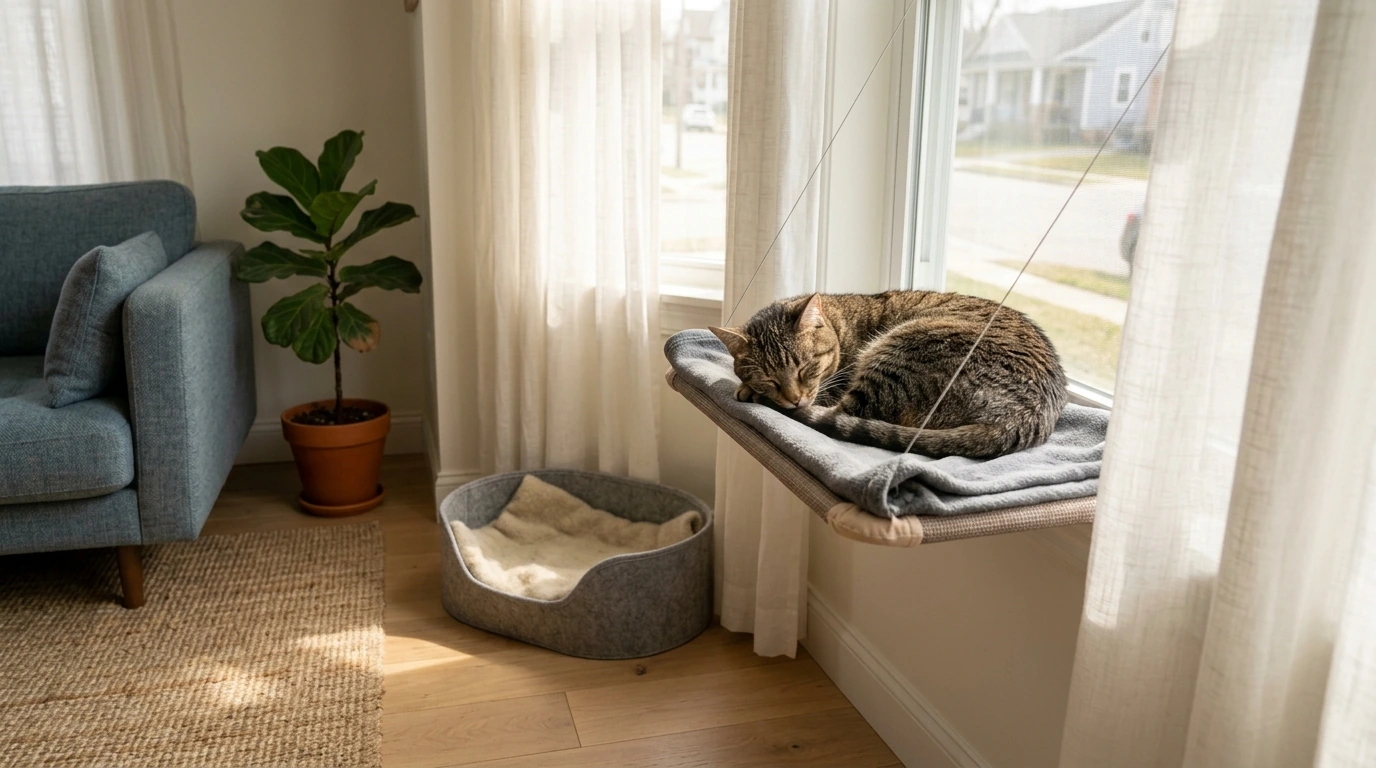
Cats sleep a lot, but they don’t sleep just anywhere. The “best” spot balances safety, warmth, privacy, and access to what matters most in the home. This guide breaks down how cats choose their sleeping places, what to look for room by room, and simple upgrades that help any cat rest more soundly—day or night.
A cat’s favorite sleeping spot usually makes perfect sense from a cat’s point of view—even when it looks odd to humans. Most choices come down to a few repeatable factors.
If your cat sleeps in a strange place (the closet floor, the top of the fridge, a laundry basket), it’s usually because that spot checks more of these boxes than the bed you picked out.
Instead of aiming for one “perfect” bed, set up a few great options that match how cats actually rest.
For a deeper, step-by-step approach to building calm rest zones (especially in busy households), consider the digital guide Catnap Haven: Choosing Your Cat’s Ideal Sleeping Spot (Digital eBook).
The best sleeping setup changes depending on confidence level, mobility, and the social dynamics in your home.
When stress is lower and resources are predictable, cats tend to sleep longer and relocate less. For more on general cat wellbeing and behavior, see resources from the Cornell Feline Health Center and the American Veterinary Medical Association (AVMA).
| What the cat does | What it usually means | Better option to offer |
|---|---|---|
| Sleeps on top of cabinets | Wants height and control of the room | Sturdy cat tree/perch with a soft mat |
| Burrows under blankets | Wants warmth and security | Covered bed or fleece-lined cave in a quiet corner |
| Moves spots all day | Chasing comfort (sun/temperature/noise) | Multiple beds: one sunny, one shaded, one quiet |
| Sleeps in the litter room | Seeking privacy or avoiding conflict | Private bed zone away from other pets; add vertical escape routes |
| Wakes easily and startles | Too much traffic/noise | Low-traffic room; add white noise or move bed away from doors |
A predictable feeding and hydration routine can also reduce roaming and middle-of-rest interruptions. If your cat tends to wake you up early or patrol the kitchen at night, a consistent setup like the Automatic Pet Feeder with Tilted Double Bowls and Water Fountain can help keep key resources steady and easy to access.
If you want a more structured plan—especially for multi-cat homes or cats that are easily startled—explore Catnap Haven: Choosing Your Cat’s Ideal Sleeping Spot (Digital eBook). It focuses on practical, room-by-room comfort upgrades, day vs. night sleep needs, covered beds, window perches, and common setup mistakes that quietly sabotage good rest.
For additional general cat-care guidance, the ASPCA Cat Care hub is a helpful reference for safe home routines and wellbeing basics.
A quiet, low-traffic spot with a predictable routine works best. Many cats prefer a bedroom corner, a stable perch, or a covered bed nearby—as long as the area is warm, safe, and not drafty.
It depends on sleep quality, allergies, and the cat’s nighttime behavior. It’s often fine if everyone rests well, but it helps to provide an attractive alternative bed in the same room so the cat has a choice.
Common causes include temperature shifts, new noise or foot traffic, social stress with other pets, or discomfort. If the change is abrupt and paired with hiding, reduced appetite, litter box changes, or signs of pain, contact a veterinarian.











Leave a comment